
In 2026, the biggest misconception is that AI content is automatically “unsafe.” The truth is simpler: value wins, fluff fades—no matter how the page was produced.
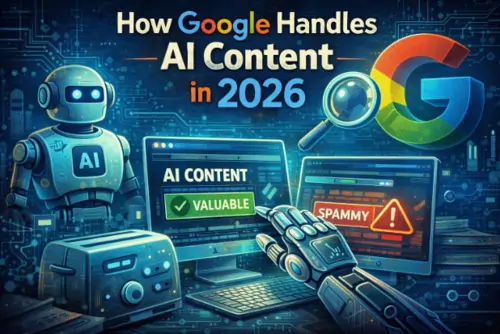
How Google Handles AI Content today is less about the tool and more about the outcome. If the page satisfies intent, demonstrates trust, and avoids mass-produced emptiness, it can compete. If it exists mainly to flood the index with recycled answers, it becomes a risk.
This guide explains how to publish AI-assisted content that stays indexable, rankable, and stable—without building your site on fragile shortcuts.
1. Google Doesn’t Rank “AI”—It Ranks Helpfulness
If you’re trying to “optimize for AI detection,” you’re solving the wrong problem.
Google’s systems are designed to reward content that:
- answers the query clearly
- provides complete coverage (not just surface definitions)
- reduces the need for users to search again
- feels written for humans, not for rankings
The Bottom Line: Whether AI helped or not, the page must deliver a better experience than what’s already ranking.
2. The Real Risk Is Scaled, Low-Value Publishing
AI didn’t create low-quality content. It made it easier to produce it faster.
The danger zone is when teams use AI to pump out:
- repetitive “SEO pages” with no real differentiation
- thin content that restates what’s already on page one
- templated articles that change only the keyword and city name
- content written to rank first, help second
That’s the pattern Google consistently tries to reduce—because it degrades search results.
The Bottom Line: Scale isn’t the problem. Scale without value is.
3. People-First Content Is the Filter
When your content is AI-assisted, you have to be extra disciplined about being people-first.
People-first pages do three things well:
- Answer early (no filler intros that delay the solution)
- Support decisions (pros/cons, criteria, comparisons, next steps)
- Add something new (experience, examples, templates, or real-world context)
This is where How Google Handles AI Content becomes obvious: pages that feel mass-produced often underperform, even if they’re technically “optimized.”
The Bottom Line: If your page exists to rank, it will eventually get weaker results. If it exists to help, it has a future.
4. “Originality” Isn’t a Buzzword—It’s the Differentiator
Most AI drafts fail because they are:
- generic
- predictable
- easily replaceable
To make AI-assisted content durable, you need human-owned originality, such as:
- first-hand testing notes
- screenshots and step-by-step walkthroughs
- local market context (pricing, PH availability, payment options, real constraints)
- specific examples and edge cases
- clear recommendations with reasoning
The Bottom Line: AI can draft structure. Humans must supply the authority.
5. Trust Signals Matter More When AI Is Involved
In 2026, trust isn’t “nice to have.” It’s what separates pages that survive from pages that get ignored.
Add trust signals directly on-page:
- visible author name + credentials (when relevant)
- sources for statistics and claims
- update dates that reflect real refreshes (not fake “updated today”)
- clear editorial standards (“reviewed by”, “tested on”, “based on”)
If you’re publishing in sensitive categories (health, finance, safety), the bar is even higher.
The Bottom Line: When readers trust you, rankings become more stable.
6. Don’t Let AI Generate Your Metadata Into Spam
A common mistake is using AI to auto-write:
- titles that overpromise
- descriptions stuffed with keywords
- FAQs that don’t match the page
- schema text that doesn’t reflect reality
This isn’t just messy—it can create inconsistency between what the page says and what the metadata claims.
The Bottom Line: Metadata should clarify the page, not exaggerate it.
7. Disclosure Works When It Adds Context
You don’t need to make AI the headline. But you should add clarity when it improves trust.
Good disclosure:
- “AI-assisted draft reviewed and edited by [Name/Role].”
- “Specs compiled from official documentation and verified on [Date].”
- “Updated after testing on [device/platform/version].”
Bad disclosure:
- “Written by AI.” (no ownership, no accountability)
This is another place How Google Handles AI Content becomes practical: accountability signals strengthen credibility.
The Bottom Line: Transparency is useful when it increases confidence—not when it’s empty labeling.
8. What “Safe” AI Content Looks Like in Practice
If you want a simple rule: publish fewer pages, make each page stronger.
A safe AI-assisted page usually has:
- one clear intent (not 3 intents jammed together)
- obvious differentiation (not a rewrite of page-one results)
- internal links that support topical authority
- a real edit pass for accuracy, tone, and completeness
- a refresh plan (content is maintained, not abandoned)
If you do this consistently, How Google Handles AI Content becomes a non-issue—because your pages behave like high-quality editorial content, not automation output.
The Bottom Line: The safest strategy is not “more content.” It’s better content with clear ownership.
9. An AI Content Workflow That Holds Up
Use this workflow to keep quality stable:
Draft
- AI creates outline + section suggestions + FAQ candidates
Enrich
- human adds experience, examples, screenshots, local context, and decisions
Verify
- fact-check claims, remove vague statements, add sources where needed
Polish
- tighten intros, improve headings, remove filler, strengthen clarity
Maintain
- schedule updates, consolidate overlaps, prune thin pages
The Bottom Line: Treat AI like a junior writer—useful, fast, and always supervised.
Final Thoughts
In 2026, AI content can rank—if it’s helpful, trustworthy, and genuinely differentiated. The sites that struggle are the ones that treat AI as a publishing machine instead of a drafting tool.
Once you align your process with real value, How Google Handles AI Content stops being scary—and becomes predictable.
Frequently Asked Questions
Can AI-assisted content rank in 2026?
Yes—when it’s accurate, intent-aligned, and adds value beyond generic summaries.
What’s the fastest way AI content fails?
Scaling thin, repetitive pages that don’t offer originality or real help.
Should I disclose AI use?
Only when it adds useful context and increases trust (e.g., reviewed by an expert, tested, verified).