

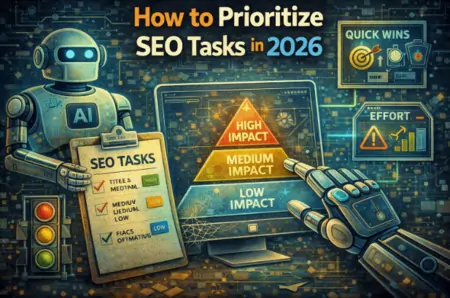
In 2026, SEO doesn’t fail because teams don’t work hard. It fails because teams spend weeks shipping the wrong work. Most backlogs are packed with SEO Tasks that feel productive but don’t move the business: rewriting every meta description, chasing perfect Lighthouse scores, adding schema everywhere, or publishing more content while the site is leaking authority through indexing and UX problems.
The goal is not to “do more SEO.” The goal is to choose SEO Tasks that create measurable impact with the least wasted effort. That requires a prioritization system—one that’s calm, data-backed, and aligned with outcomes like leads, sales, bookings, and qualified traffic.
This guide gives you a practical framework you can use weekly and monthly, whether you’re an agency, a solo SEO, a publisher, an e-commerce team, or a local business operating in a competitive market like the Philippines.
1) Start With Outcomes, Not SEO Metrics
Rankings are not the goal. Traffic is not the goal. “Green scores” are definitely not the goal.
Outcomes are the goal:
- revenue
- leads
- sign-ups
- calls
- bookings
- qualified visitors who convert
When you filter SEO Tasks through business outcomes, a lot of “important” work loses priority instantly. For example, updating titles on pages that already attract high-intent impressions can produce more leads this month than publishing ten new informational posts that never convert.
Practical move: define your top 3 outcomes for the quarter, then ask:
- Which pages drive these outcomes?
- Which bottlenecks block those pages from performing?
The Bottom Line: If a task can’t connect to an outcome, it’s usually not urgent.
2) Use a 3-Score Filter: Impact, Effort, Confidence
In 2026, prioritization needs more than “this seems important.” Use a simple scoring system for your SEO Tasks:
Impact: How much could it improve traffic, conversions, or stability?
Effort: How long will it take, and how many dependencies exist (dev, design, approvals)?
Confidence: Do you have data supporting it, or are you guessing?
High-priority work is typically:
- high impact
- low-to-medium effort
- high confidence
Low priority work is typically:
- high effort
- vague impact
- low confidence
This is how you stop doing tasks that only “feel” like SEO.
The Bottom Line: When confidence is low, don’t overinvest.
3) Fix Leaks Before You Build New Pipelines
Most sites are leaking.
Not dramatically. Quietly.
Common leak patterns:
- pages get impressions but low clicks
- users land, then bounce fast
- Google crawls but doesn’t index key URLs
- internal links don’t support priority pages
- duplicate pages dilute authority
When you ignore these issues and keep publishing, you’re adding water to a bucket with holes. The smartest SEO Tasks often feel small: fixing CTR, consolidating cannibalized content, tightening index control, and cleaning internal link pathways.
Start by identifying your “leaks”:
- high impressions + low CTR pages
- pages with declining clicks
- pages with high bounce or low engagement
- “crawled/discovered not indexed” clusters
- redirect chains or broken internal links
The Bottom Line: Fixing leaks compounds faster than creating new pages.
4) Prioritize Pages, Not “Sitewide” Projects
Sitewide tasks are seductive because they feel complete:
- “Update all meta descriptions”
- “Add schema to every post”
- “Optimize every image”
- “Rewrite all old content”
But sitewide SEO Tasks are often slow, expensive, and low ROI because they include pages that don’t matter.
Instead, prioritize by page groups:
- top organic landing pages
- top revenue / lead pages
- pages with high impression demand
- pages on the main conversion path
- pages with backlinks pointing to them
A small change on your top 20 pages can beat a massive project across 2,000 URLs.
The Bottom Line: Focus where traffic and conversions already exist.
5) Use Google Search Console as Your Priority Engine
If you want a data-driven backlog, build it from Search Console signals.
Search Console helps you find:
- pages with high impressions but weak CTR (title and snippet wins)
- queries with rising impressions (new demand)
- pages losing clicks (decay, intent mismatch, SERP change)
- pages ranking for unexpected queries (scope confusion)
- cannibalization (multiple pages fighting)
These insights turn random SEO Tasks into targeted fixes. Instead of “we should optimize content,” you can say:
“Page X has high impressions for queries Y and Z, but CTR is low. We’ll rewrite title/meta and restructure the intro for intent match.”
The Bottom Line: Don’t guess where opportunity is—use evidence.
6) Triage Technical SEO by Indexing and Crawl Impact
Technical SEO is a black hole if you let it be.
In 2026, prioritize technical SEO Tasks that affect:
- indexing eligibility
- crawl efficiency
- canonical clarity
- page experience on key pages
- redirects and internal link health
High-impact technical work:
- addressing “crawled/discovered not indexed” patterns
- controlling duplicate URLs from tags, filters, parameters
- fixing canonical inconsistencies
- removing redirect chains on important pages
- improving performance on top landing pages
Low-impact technical distractions:
- chasing perfect Lighthouse scores sitewide
- micro-optimizing low-traffic pages
- making changes without a hypothesis
The Bottom Line: If it doesn’t protect indexing or experience, it’s not urgent.
7) Content Priorities: Refresh > Expand > Create
Publishing more content is the default behavior of teams that don’t have a system. In 2026, the smarter sequence for SEO Tasks is:
Refresh: pages that already rank but are decaying
Expand: pages that rank but don’t fully satisfy intent
Create: new pages only when there’s a real gap and clear demand
Refreshing is often the highest ROI because the page already has:
- rankings history
- backlinks
- internal associations
- query coverage
A strong refresh includes:
- updated examples and sections
- better structure and readability
- expanded subtopics that users expect
- stronger internal links into and out of the page
The Bottom Line: Maintain winners before you build new experiments.
8) Authority Priorities: Earned Signals Beat Manufactured Signals
Link building still matters, but the best strategy is to treat authority like reputation.
Prioritize SEO Tasks that earn real validation:
- digital PR
- original data assets
- partnerships that make business sense
- citations and references that would exist even without SEO
Deprioritize manufactured authority:
- paid placements disguised as editorial
- low-quality mass guest posting
- shortcuts that create a pattern risk
The Bottom Line: Earned authority compounds; manufactured authority breaks.
9) Build a Weekly and Monthly Operating System
Prioritization fails when it’s a one-time workshop. You need cadence.
Weekly SEO Tasks
- check top GSC changes (clicks, impressions, CTR)
- fix quick CTR wins
- add internal links to priority pages
- watch indexing anomalies or spikes in excluded pages
Monthly SEO Tasks
- refresh 2–6 decaying pages
- prune or noindex thin pages causing index noise
- audit internal link hubs and orphan pages
- review performance on top landing pages
Quarterly SEO Tasks
- consolidate cannibalized topics
- plan topic clusters based on demand trends
- run technical health review focused on indexing/crawl
- align SEO roadmap with product and marketing plans
The Bottom Line: A system beats a backlog.
10) A Simple Prioritization Template You Can Copy
Use this template to turn ideas into decision-ready SEO Tasks:
Task:
Target pages:
Business outcome: (leads/sales/bookings)
Data signal: (GSC trend, indexing issue, CTR gap)
Hypothesis: (what will improve and why)
Effort: (hours + dependencies)
Impact: (high/medium/low)
Confidence: (high/medium/low)
Next action: (specific, measurable)
If a task has no data signal and no hypothesis, it’s usually not ready.
The Bottom Line: If you can’t explain why you’re doing it, don’t do it yet.
Final Thoughts
In 2026, SEO is too complex to run on intuition. The teams that win are the ones that prioritize calmly, using outcomes and evidence—not noise.
When you choose SEO Tasks based on impact, effort, and confidence, you stop being busy and start shipping work that compounds: CTR wins, internal link improvements, content refreshes, indexing cleanup, and technical fixes that protect visibility.
The result isn’t just better rankings. It’s stability—and a workflow you can repeat every month.
Frequently Asked Questions
What should I prioritize first if my traffic dropped?
Use Search Console comparisons to see which page types lost clicks, then diagnose intent, indexing, or UX issues before editing anything.
Technical SEO or content first?
Fix technical issues that block indexing and crawl efficiency first, then invest in content upgrades and intent alignment.
How do I prioritize as a small team?
Focus on the highest-impact pages and fastest wins: CTR, internal links, content refreshes, and pruning thin pages.