
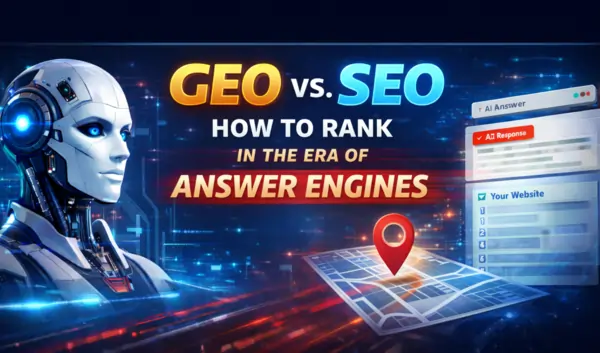
GEO vs. SEO is not just a buzzword battle; it is the single most critical pivot I have witnessed in my nearly two decades in this industry.
I remember the panic when the Penguin update hit in 2012. I remember the “Mobilegeddon” scares that kept us up at night, and the pivot to voice search that promised to change everything but only changed some things. But this? This is different. We are no longer just optimizing for a search engine that retrieves lists of websites; we are optimizing for “Answer Engines” that think, synthesize, and decide if you are worth mentioning.
If you are still stuffing keywords into H2 tags expecting to win in 2026, you are fighting a modern war with weapons from 2015. Here is the raw reality of the landscape today.
Table of Contents
The Paradigm Shift: From Blue Links to “The Answer”
For the last 18 years, my job—and likely yours—was to get a user to click a blue link. We optimized for Click-Through Rate (CTR) and time-on-page.
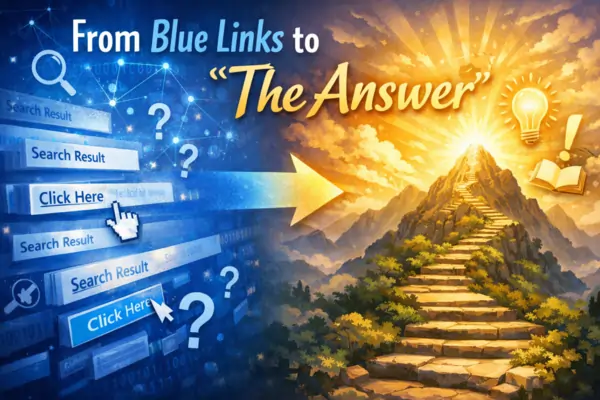
But looking at the rise of Perplexity, ChatGPT Search, and Google’s evolved AI Overviews, the goal post has moved. The user doesn’t want to click; they want the answer now. They want the “Zero-Click” resolution.
This is where Generative Engine Optimization (GEO) enters the chat. GEO is the art and science of formatting, structuring, and verifying content so that Large Language Models (LLMs) can easily read, understand, and—most importantly—cite your content as the source of truth.
Read The original academic paper that coined the term “GEO.”
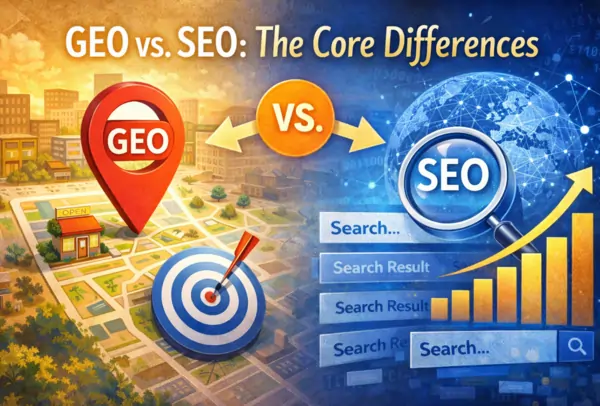
GEO vs. SEO: The Core Differences
To survive this shift, you have to understand the mechanics under the hood. When we analyze GEO vs. SEO, the divergence comes down to how the engine values your content.
The Comparison Matrix
| Feature | Traditional SEO | Generative Engine Optimization (GEO) |
| Primary Goal | Ranking #1 on the SERP (Search Engine Results Page). | Being the “Cited Source” in the AI snapshot. |
| Ranking Signal | Backlinks & Keywords. | Brand Mentions & Semantic Authority. |
| Content Style | Comprehensive, long-form guides. | Concise, fact-dense, “inverted pyramid” style. |
| User Journey | Search -> Click -> Read -> Convert. | Search -> Read AI Answer -> Trust Brand. |
| Technical Focus | Crawlability & Indexing. | Structure (Schema) & Vector Space relevance. |
Export to Sheets
In traditional SEO, you could “fake” authority with enough PBN links or aggressive outreach. In the GEO vs. SEOdebate, GEO is ruthless. LLMs are trained on massive datasets. If your brand isn’t semantically associated with your topic in the “Knowledge Graph,” no amount of link building will force the AI to recommend you.
The 3 Pillars of GEO Ranking Strategy
If you want to win the GEO vs. SEO battle, you need to change how you write and how you structure your digital presence. I call this the “Feed the Machine” strategy.
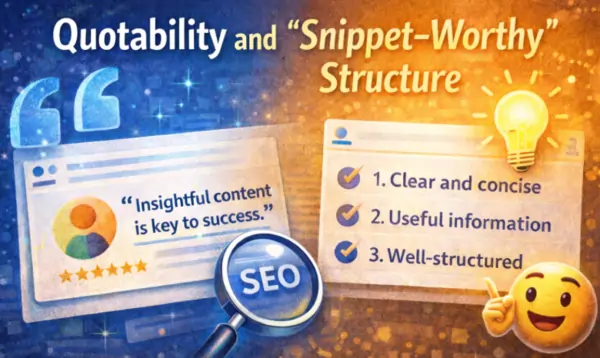
1. Quotability and “Snippet-Worthy” Structure
AI Agents are essentially lazy researchers. They look for information that is easy to extract and summarize. To optimize for this, use the Inverted Pyramid style of journalism.
- The Mistake: Burying the answer at the bottom of a 2,000-word post to keep users on the page longer.
- The Fix: Provide a direct, concise answer immediately after the heading.
Example:
- Bad (Old SEO): “When considering the differences between these two methodologies, it is important to note…”
- Good (GEO): “The main difference in GEO vs. SEO is that SEO targets search algorithms, while GEO targets Large Language Model training data.”
Pro-Tip: Use distinct statistics and unique data points. LLMs love data because it grounds their “hallucinations” in fact. If you provide the stat, you get the citation.
2. E-E-A-T is Your Only Moat
In a world where AI can generate average content in seconds, “Experience” (from Google’s E-E-A-T framework) is your only defense. An AI cannot go to a wet market in Phnom Penh and smell the spices. I can. You can.

Injecting personal anecdotes, first-person language (“I found that…”), and contrarian opinions signals to the engine that a human is behind the wheel. This “humanity” is a ranking factor now. The AI knows it cannot replicate genuine human experience, so it cites it instead.
3. Fluency and Contextual Entities
Keyword stuffing confuses LLMs. They rely on Natural Language Processing (NLP) to understand context. Instead of repeating “Best SEO Tool” 50 times, focus on Entity Density.
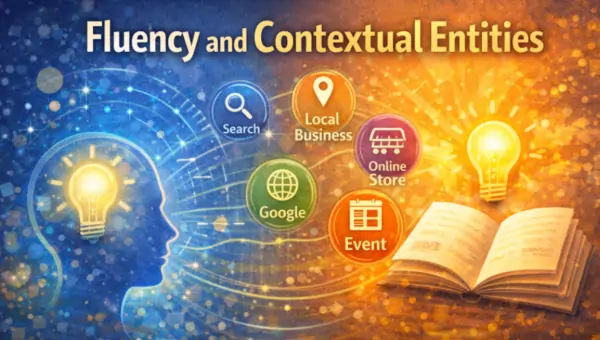
You want the AI to understand the relationship between your brand and the solution. You do this by ensuring your brand appears alongside relevant concepts (e.g., “ROI,” “Digital Marketing,” “Audit”) in authoritative places across the web.
Optimizing for the “RAG” (Retrieval-Augmented Generation)
This is the technical heart of the GEO vs. SEO discussion. Modern search uses RAG—Retrieval-Augmented Generation. The AI looks for live data to supplement its pre-trained knowledge.
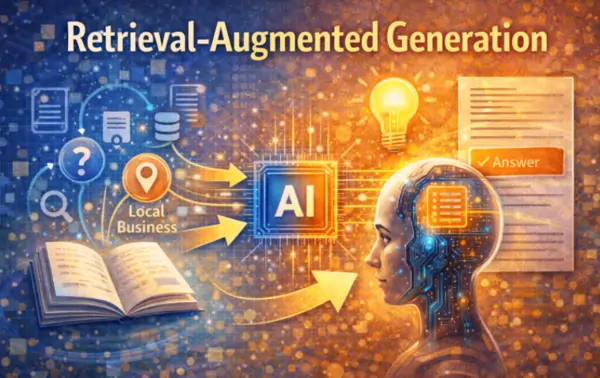
To ensure your content is “retrieved” during this live lookup:
- Schema Markup: Your schema must be flawless. You are essentially translating your website into a language the robot speaks natively. Use
Citationschema andSpeakableschema to flag important sections. - Freshness Signals: Update your “Last Modified” dates genuinely. RAG systems prioritize recent data to avoid giving outdated answers.
- Vector Search Optimization: Ensure your content answers specific, long-tail questions that match the “embeddings” (mathematical representations of meaning) that users are searching for.
Measuring Success in a GEO vs. SEO World
This is the hardest pill for my clients to swallow: Traffic might go down, but conversion should go up.
In the GEO vs. SEO landscape, we are moving toward a “Zero-Click” reality. If the AI answers the user’s question using your content, they might not visit your site. But if the answer is “According to Jin Grey…” you have won mindshare.
So, how do we measure success?
- Share of Model (SoM): This is the new Share of Voice. How often is your brand mentioned in AI answers for your core topics?
- Brand Search Volume: Are users impressed enough by the AI snippet to search for your brand specifically? This is the ultimate metric of trust.
- Entity Sentiment: Is the AI associating positive or negative sentiment with your brand name?
The Verdict: Adapt or Die
The debate of GEO vs. SEO isn’t about one replacing the other—it’s about evolution. SEO ensures you are visible in the index; GEO ensures you are the chosen answer in the output.
As someone who has navigated the digital landscape for 18 years, through poverty and success, from the Philippines to Cambodia, my advice is simple: Stop writing for algorithms that count keywords. Start writing for engines that read for meaning.
The “Blue Link” era is ending. The “Answer Era” is here. Are you ready to be the source?
Need help transitioning your strategy from traditional search to the AI era? Connect with me, Jin Grey, for a full audit of your GEO vs. SEO readiness.