
Search didn’t disappear.
Keywords didn’t vanish.
But the way keywords work has fundamentally changed.
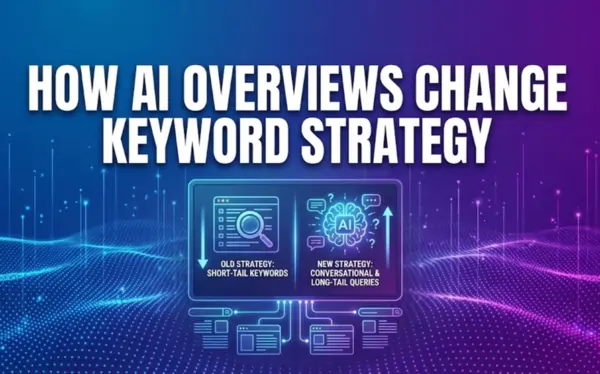
If you’re still doing keyword research the same way you did before AI Overviews, you’re already behind — not because SEO stopped working, but because keyword strategy evolved faster than most people noticed.
AI Overviews didn’t kill SEO.
They changed how queries are answered — and by extension, how keywords should be targeted.
This article explains exactly how AI Overviews change keyword strategy, what no longer works, what still does, and how to adapt without chasing trends or panic-optimizing.
Table of Contents
What Are AI Overviews (And Why They Matter for Keyword Strategy)
AI Overviews are Google’s AI-generated summaries that appear above traditional organic results for many informational and exploratory queries.
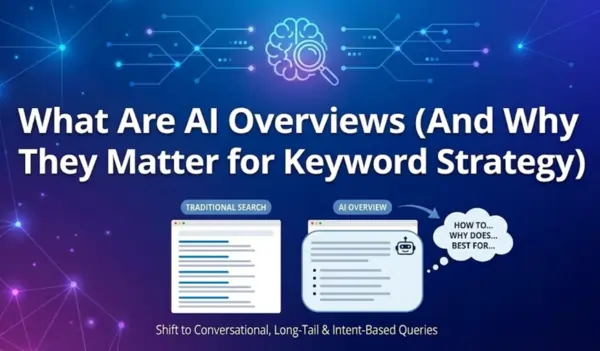
Instead of showing ten blue links immediately, Google now:
- Interprets the query
- Synthesizes multiple sources
- Presents a summarized response
- Then links out selectively
This matters because ranking alone no longer guarantees visibility.
If your content doesn’t:
- Align with how AI interprets intent
- Provide structured, extractable information
- Offer unique or authoritative signals
…it may never be surfaced — even if it technically “ranks.”
This is why AI Overviews change keyword strategy at a foundational level, not just a tactical one.
Why Traditional Keyword Strategy Is No Longer Enough

Old keyword strategy was built on assumptions like:
- Rank #1 = traffic
- Higher volume = better keyword
- One keyword = one page
- Exact match matters most
AI Overviews break those assumptions.
Now, Google doesn’t just match keywords — it resolves intent and constructs answers.
This means:
- Some keywords lose clicks even when ranked
- Some low-volume queries gain visibility
- Some pages are used as sources instead of destinations
Keyword strategy must now account for visibility without clicks, partial attribution, and entity-level relevance.
How AI Overviews Change Keyword Strategy at the Intent Level
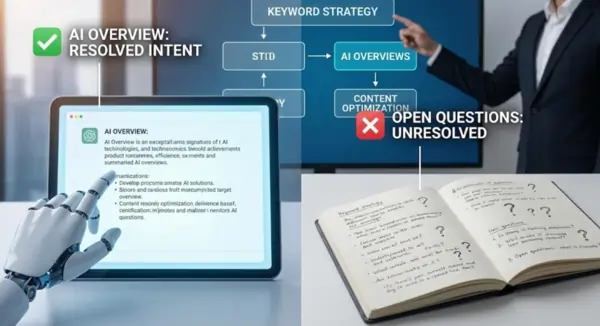
AI Overviews Favor Resolved Intent, Not Open Questions

Queries most affected by AI Overviews are:
- “What is…”
- “How does…”
- “Why does…”
- “Best way to…”
- “Difference between…”
These are intent-resolution queries, not transactional ones.
If your keyword strategy focuses only on:
- Volume
- CPC
- Difficulty scores
You miss the bigger picture.
AI Overviews change keyword strategy by prioritizing intent clarity over keyword targeting.
Keyword Strategy Now Starts With Query Type
Before choosing a keyword, ask:
- Is this query informational, exploratory, or transactional?
- Does it require synthesis or comparison?
- Would a single page realistically answer it?
If yes, AI Overviews are likely involved.
This doesn’t mean you avoid these keywords — it means you approach them differently.
Keyword Strategy in the Age of AI Overviews

1. From Keywords to Query Clusters
AI Overviews don’t pull from single keywords.
They pull from conceptual clusters.
Instead of targeting:
“technical SEO checklist”
You must support:
- What technical SEO is
- Why it matters
- Common issues
- Tools
- Best practices
- Mistakes
AI Overviews change keyword strategy by rewarding topical completeness, not isolated optimization.
2. From Exact Match to Semantic Coverage
Exact match keywords still matter — but they’re no longer the center.
What matters more:
- Clear definitions
- Consistent terminology
- Semantic relationships
- Logical structure
AI Overviews extract meaning, not phrasing.
This is why keyword strategy now overlaps heavily with entity SEO and information architecture.
How AI Overviews Change Keyword Strategy for Content Creation
Content Must Be Extractable
AI systems favor content that is:
- Clearly structured
- Scannable
- Fact-based
- Direct
This means:
- Strong subheadings
- Clear definitions
- Bullet points where appropriate
- No filler introductions
If your content buries answers under storytelling, AI will skip it.
Keyword strategy now includes how content is parsed — not just what it targets.
Long Content Still Works — But Only If Structured
Long-form content is not dead.
Unstructured long-form content is.
AI Overviews change keyword strategy by rewarding:
- Hierarchical structure
- Logical flow
- Intent alignment
2,500 words only help if each section reinforces the topic.
How AI Overviews Change Keyword Strategy for Clicks
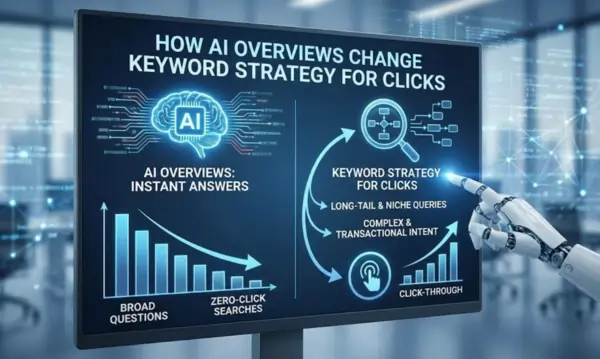
Visibility ≠ Clicks
Some keywords now deliver:
- Impressions
- Brand recognition
- Authority signals
…but fewer clicks.
This doesn’t mean the keyword failed.
It means its role changed.
Keyword strategy must now consider:
- Brand exposure
- Assisted conversions
- Attribution beyond last click
Ignoring these keywords weakens long-term authority.
Keywords That Still Perform Well Post-AI Overviews

AI Overviews don’t dominate everything.
Keywords that still drive clicks:
- Transactional queries
- Branded queries
- Local intent queries
- Product comparisons
- Deep technical problems
Keyword strategy in 2026 is about balance, not avoidance.
How AI Overviews Change Keyword Strategy for SEOs
SEOs Must Think Like Information Architects
Keyword research alone is insufficient.
Modern SEO requires:
- Understanding how information connects
- Mapping intent journeys
- Supporting entities, not pages
AI Overviews change keyword strategy by shifting focus from ranking pages to supporting answers.
SEO Tools Lag Behind Reality
Most keyword tools:
- Still focus on volume
- Don’t measure AI exposure
- Don’t reflect visibility loss accurately
Human judgment matters more than tool scores.
How AI Overviews Change Keyword Strategy for New Sites
New sites should:
- Avoid broad “what is” keywords early
- Focus on specific problems
- Build depth before breadth
AI Overviews favor trusted sources.
Keyword strategy must align with authority maturity.
Common Keyword Strategy Mistakes After AI Overviews
- Avoiding informational keywords entirely
- Publishing thinner content to “beat AI”
- Over-optimizing for featured snippets
- Ignoring structure
- Chasing trends instead of patterns
AI Overviews don’t punish SEO.
They punish low-effort execution.
The Right Way to Adapt Keyword Strategy
Build Topic Systems, Not Keyword Lists
Think in terms of:
- Pillars
- Supporting content
- Internal reinforcement
Keyword strategy becomes site strategy.
Measure Visibility, Not Just Traffic
Track:
- Impressions
- Branded search growth
- Assisted conversions
- Internal link performance
AI Overviews change keyword strategy by redefining success metrics.
Final Thoughts: AI Overviews Didn’t Kill Keywords — They Matured Them
Keywords still matter.
They just no longer work alone.
AI Overviews force SEO to:
- Grow up
- Think structurally
- Focus on clarity and usefulness
This is not the end of keyword strategy.
It’s the end of lazy keyword strategy.
Frequently Asked Questions
How do AI Overviews change keyword strategy?
AI Overviews change keyword strategy by shifting SEO focus from ranking individual keywords to supporting complete answers. Search engines now prioritize intent resolution, semantic coverage, and content structure over exact keyword matching alone.
Do keywords still matter with AI Overviews?
Yes, keywords still matter. However, AI Overviews change keyword strategy by reducing reliance on single keywords and increasing the importance of topic clusters, contextual relevance, and entity-based optimization.
Should SEOs avoid informational keywords because of AI Overviews?
No. AI Overviews change keyword strategy, but informational keywords still play a critical role in visibility, authority building, and assisted conversions. The key is structuring content so it can be extracted and referenced by AI systems.
How should keyword research change in 2026?
In 2026, keyword research should focus less on volume alone and more on intent type, query relationships, and topical depth. AI Overviews change keyword strategy by rewarding sites that answer connected questions rather than isolated search terms.
Do AI Overviews reduce organic traffic?
AI Overviews can reduce clicks for some queries, but they increase visibility for trusted sources. AI Overviews change keyword strategy by making impressions, brand exposure, and assisted engagement more important metrics alongside traffic.
What types of keywords still drive clicks despite AI Overviews?
Transactional, branded, local, comparison-based, and problem-specific keywords continue to drive clicks. AI Overviews change keyword strategy mainly for broad informational queries, not high-intent searches.
How can content be optimized for AI Overviews?
Content should be clearly structured, concise, and intent-focused. AI Overviews change keyword strategy by favoring content that provides direct answers, logical sections, and semantically complete explanations.
Is AI-generated content bad for SEO in 2026?
AI-generated content is not inherently bad. AI Overviews change keyword strategy by exposing low-effort content, not by penalizing AI itself. Human oversight, structure, and originality remain essential.
Do SEO tools accurately track AI Overview impact?
Most SEO tools lag behind AI Overview behavior. AI Overviews change keyword strategy faster than tools can measure, which makes human judgment and SERP observation more important than tool metrics alone.
How can new websites adapt keyword strategy with AI Overviews?
New websites should focus on specific problems, niche authority, and structured content. AI Overviews change keyword strategy by favoring trusted sources, so new sites must build depth before targeting broad queries.
Resources & Further Reading
- Google Search Central – AI and Search
https://developers.google.com/search/blog/2023/02/google-search-and-ai-content
Google’s official explanation of how AI-generated and AI-assisted content is handled in search. - Google Search Central Documentation
https://developers.google.com/search/docs
Core reference for crawling, indexing, page quality, and how Google understands content. - Google Search Central Blog
https://developers.google.com/search/blog
Official updates on ranking systems, spam policies, and search behavior changes. - Search Engine Land – AI Overviews Coverage
https://searchengineland.com/tag/ai-overviews
Industry analysis and reporting on how AI Overviews affect organic search and visibility. - Search Engine Journal – SEO & AI
https://www.searchenginejournal.com/category/artificial-intelligence/
Practical SEO commentary on AI-driven SERP changes and keyword strategy evolution. - Ahrefs Blog – Keyword Research & Search Intent
https://ahrefs.com/blog
Data-backed insights on keyword behavior, intent modeling, and search trends. - Screaming Frog Blog – Technical SEO & Crawling
https://www.screamingfrog.co.uk/blog/
Technical perspective on how search engines crawl, parse, and extract content.
Author Reference
- JinGrey.com
https://jingrey.com
Personal site by Jin Grey, sharing experience-led insights on full-stack SEO, technical foundations, keyword strategy, and educational SEO eBooks.
Written by Jin Grey
Jin Grey is a Full-Stack SEO Expert with 18+ years of hands-on experience across technical SEO, content systems, and long-term search strategy. She writes from real-world testing and execution, not theory.
Jin also publishes practical SEO eBooks focused on building sustainable SEO systems, technical foundations, and modern search strategy. More of her work is available at jingrey.com.