
Most SEO advice didn’t become wrong overnight.
It became irrelevant quietly.
In 2026, a large portion of SEO guidance still circulating online is based on:
- how Google worked years ago
- metrics that no longer drive decisions
- tactics that only functioned when systems were less sophisticated
The result?
Teams follow advice that feels familiar, looks “best practice,” and delivers shrinking returns—or worse, unstable rankings.
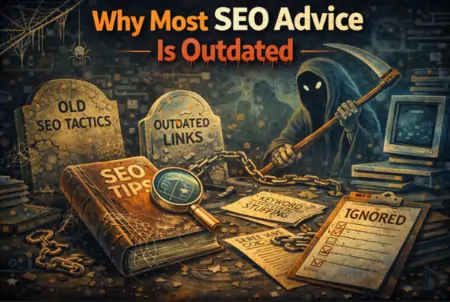
This article explains why most SEO advice is outdated, how to recognize it quickly, and what actually replaces it in a modern SEO system.
Why Most SEO Advice Is Outdated
- It’s Built for Old Google, Not Modern Systems
- It Confuses Checklists With Strategy
- It Overvalues Keywords and Undervalues Intent
- It Treats Content as Output, Not Assets
- It Ignores How Google Evaluates Quality at Scale
- It Promotes Tools as Strategy
- It Assumes SEO Is Static
- It Separates Technical, Content, and UX SEO
- It Encourages Reactive Optimization
- It Optimizes for Metrics That Don’t Drive Outcomes
1. It’s Built for Old Google, Not Modern Systems
Much SEO advice is still optimized for a version of Google that:
- relied heavily on exact keywords
- evaluated pages in isolation
- struggled with context and semantics
Modern Google systems evaluate:
- topical authority
- intent satisfaction
- site-wide quality signals
- user behavior patterns over time
Advice that focuses on “perfecting a single page” without considering the site as a system is outdated by default.
The Bottom Line: Google evaluates ecosystems now, not standalone pages.
2. It Confuses Checklists With Strategy
Checklists feel safe.
But SEO checklists often turn tactics into dogma:
- add X internal links
- hit Y word count
- reach Z keyword density
These steps aren’t strategies—they’re execution details that only work when aligned with intent, context, and site structure.
Outdated advice teaches:
“Do these steps and rankings will follow.”
Modern SEO requires:
“Understand the problem first. Then decide what matters.”
The Bottom Line: Strategy decides what to do. Checklists only decide how.
3. It Overvalues Keywords and Undervalues Intent
Keyword obsession is one of the clearest signs of outdated SEO thinking.
In 2026:
- one page ranks for dozens (or hundreds) of related queries
- Google evaluates whether a page satisfies the reason behind a search
- exact-match targeting is no longer a competitive edge
Yet outdated advice still pushes:
- one keyword = one page
- keyword density targets
- rewriting content to “add more keywords”
The Bottom Line: Intent alignment beats keyword repetition every time.
4. It Treats Content as Output, Not Assets
Old SEO advice treats publishing as the finish line.
Modern SEO treats publishing as version 1.
Outdated content advice:
- publish often
- move on quickly
- never look back
What actually works:
- updating decaying pages
- consolidating overlapping content
- strengthening internal links
- improving clarity and depth over time
The Bottom Line: Content that isn’t maintained eventually becomes a liability.
5. It Ignores How Google Evaluates Quality at Scale
Most outdated SEO advice is written for individual pages, not entire sites.
But in 2026, Google evaluates patterns:
- thin content at scale
- duplicated formats across hundreds of URLs
- inconsistent trust signals
- bloated indexes
You can’t out-optimize a weak system with isolated fixes.
The Bottom Line: Site-wide quality matters more than isolated perfection.
6. It Promotes Tools as Strategy
Tools are helpful.
But outdated advice often sounds like:
- “Install this plugin and you’re SEO-ready”
- “This tool will fix your rankings”
- “Follow the score”
Tools don’t understand:
- your business model
- your audience
- your competitive landscape
- your content gaps
They assist execution—but they don’t replace thinking.
The Bottom Line: Tools support strategy. They don’t create it.
7. It Assumes SEO Is Static
Old SEO advice assumes:
- rules are fixed
- tactics stay effective
- best practices don’t expire
Modern SEO is adaptive:
- SERP layouts change
- intent shifts
- competitors evolve
- user expectations rise
Advice that doesn’t account for change becomes wrong—even if it was once right.
The Bottom Line: SEO is a moving system, not a frozen rulebook.
8. It Separates Technical, Content, and UX SEO
Outdated SEO treats these as separate disciplines.
Modern SEO knows they’re inseparable.
Examples:
- slow UX hurts content performance
- weak internal linking limits crawl efficiency
- poor structure undermines great writing
SEO works when:
- technical foundations are clean
- content satisfies intent
- UX supports consumption
The Bottom Line: SEO is systems engineering, not siloed tasks.
9. It Encourages Reactive Optimization
Outdated advice trains SEOs to:
- panic after updates
- change pages immediately
- “fix” rankings without diagnosis
Modern SEO teams:
- wait for data stabilization
- analyze patterns, not anecdotes
- make deliberate changes
Reaction creates chaos. Diagnosis creates clarity.
The Bottom Line: Calm SEO beats fast SEO.
10. It Optimizes for Metrics That Don’t Drive Outcomes
Old advice focuses on:
- keyword rankings alone
- raw traffic volume
- arbitrary scores
Modern SEO focuses on:
- qualified traffic
- engagement and satisfaction
- conversions and revenue impact
- index health and crawl efficiency
Metrics are tools—not goals.
The Bottom Line: If a metric doesn’t influence decisions, stop optimizing for it.
Final Thoughts
Most SEO advice is outdated because it’s frozen in time.
It was written for:
- older algorithms
- simpler SERPs
- less competition
- weaker quality evaluation
In 2026, SEO works when you:
- think in systems, not tactics
- prioritize intent and usefulness
- maintain content like products
- build trust and clarity at scale
The goal isn’t to follow advice.
It’s to understand why advice worked—and why it stopped.
That’s how you future-proof SEO.
Frequently Asked Questions
Is all old SEO advice wrong?
No. Many fundamentals still apply—but they must be applied in modern context.
What’s the fastest way to spot outdated advice?
If it focuses on single keywords, rigid formulas, or guarantees rankings, it’s likely outdated.
What should replace outdated SEO advice?
Intent-first strategy, topical authority, technical cleanliness, and continuous optimization.