
AI didn’t just change how content is produced.
It changed how easy it is to pollute the web.
In an AI-first world, SEO ethics isn’t a philosophical debate. It’s a practical question:
Are you building long-term trust—or short-term visibility that collapses the moment platforms tighten quality standards?
Because in 2026, the biggest competitive advantage isn’t the fastest content output.
It’s credibility.
SEO Ethics is how you scale without becoming spam. It’s how you win rankings without teaching your team that manipulation is strategy. And it’s how you protect your brand when AI makes shortcuts cheap—and consequences expensive.
This guide breaks down what SEO Ethics looks like now, what crosses the line, and how to build a content system you can defend publicly.
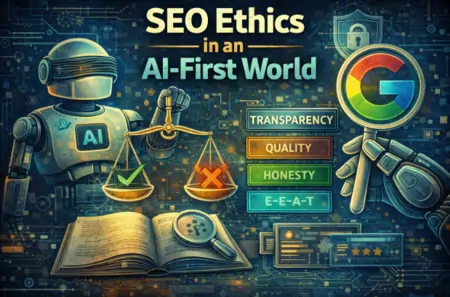
SEO Ethics in an AI-First World
- Ethics Isn’t “Nice”—It’s Risk Management
- The New Spam Isn’t Obvious Anymore
- Transparency Builds Trust (And Stability)
- Originality Is a Responsibility, Not a Style Choice
- Accuracy Is Non-Negotiable
- YMYL: The Higher Standard
- Link Building Ethics in 2026
- Avoiding “Authority Borrowing” Tactics
- Responsible AI Workflows for SEO Teams
- An Ethical SEO Checklist You Can Actually Use
1. Ethics Isn’t “Nice”—It’s Risk Management
SEO Ethics is often framed as morals.
In reality, it’s governance.
Because the SEO tactics most likely to drive short-term gains are also the tactics most likely to create:
- future penalties or devaluations
- lost trust from users
- brand reputation damage
- unstable rankings after updates
- internal team chaos (“Do we stand by what we publish?”)
The Bottom Line: SEO Ethics is how you prevent your SEO strategy from becoming a liability.
2. The New Spam Isn’t Obvious Anymore
Old spam looked like spam.
AI spam looks like a well-formatted article with headings, bullet points, and “professional tone”—but it still provides:
- nothing new
- nothing tested
- nothing trustworthy
- nothing that helps beyond what already exists
That’s why the ethical problem isn’t “using AI.”
It’s using AI to manufacture output that imitates value.
The Bottom Line: If it exists mainly to rank, it’s already drifting toward abuse.
3. Transparency Builds Trust (And Stability)
Transparency is not about shouting “AI wrote this!”
It’s about owning responsibility for what you publish.
SEO Ethics signals include:
- clear author identity
- editorial review standards
- citations for key claims
- update timestamps that reflect real changes
- disclaimers where needed (especially for sensitive advice)
If your content can’t survive a reader asking:
“Who wrote this, and why should I trust it?”
…then your SEO system is fragile.
The Bottom Line: Trust signals are ethical—and they’re ranking stability signals too.
4. Originality Is a Responsibility, Not a Style Choice
In an AI-first world, originality becomes ethics.
Why?
Because the internet doesn’t need another 500 copies of the same “What is SEO?” post.
Publishing recycled content at scale creates harm:
- wastes user time
- clutters search results
- pushes out truly original creators
- lowers information quality overall
SEO Ethics requires adding value that wouldn’t exist without you:
- real examples
- tested workflows
- case studies
- local context (especially for PH audiences)
- specific recommendations with reasoning
The Bottom Line: Originality isn’t branding. It’s your contribution to the ecosystem.
5. Accuracy Is Non-Negotiable
AI makes it easy to sound correct while being wrong.
Ethically, that’s dangerous.
Especially when:
- readers act on advice
- businesses spend money based on your recommendations
- topics involve health, legal, finance, or security
- misinformation spreads through republishing and scraping
If your process doesn’t include fact-checking, you’re not publishing content—you’re publishing risk.
The Bottom Line: Accuracy is the minimum ethical standard for AI-assisted SEO Ethics.
6. YMYL: The Higher Standard
If your content touches topics that impact someone’s safety, health, or financial wellbeing, ethics is no longer optional.
YMYL content demands:
- expert review
- verified sources
- conservative claims
- clear limitations
- no “confidence theater” writing
In the Philippines especially, where readers may rely on online information to make major decisions, low-quality advice is not just “bad SEO.” It’s harm.
The Bottom Line: On YMYL topics, SEO Ethics means professional-grade responsibility.
7. Link Building Ethics in 2026
Backlinks still matter.
But the ethical line is clear:
- Earn links through value (PR, partnerships, data, tools)
- Don’t manufacture authority through deceptive placements
Ethical link building looks like:
- digital PR with real stories
- citations from relevant publishers
- partnerships that make sense beyond SEO
- community involvement and real references
Unethical link building looks like:
- paid links disguised as editorial
- mass guest post factories
- “renting” authority on other domains
- link schemes that exist only to influence rankings
The Bottom Line: If a link wouldn’t exist without SEO Ethics manipulation, it’s probably not worth defending.
8. Avoiding “Authority Borrowing” Tactics
In an AI-first world, a common unethical shortcut is “borrowed authority.”
This includes tactics like:
- publishing third-party pages on high-authority domains to rank faster
- creating subdomains purely to exploit trust signals
- placing content where the host site has no editorial standards
These approaches can work short-term, but they erode trust in the ecosystem—and they’re increasingly targeted.
The Bottom Line: Borrowed authority is temporary. Real authority compounds.
9. Responsible AI Workflows for SEO Teams
SEO Ethics isn’t just “don’t do bad things.”
It’s building a workflow that prevents harm by default.
A responsible AI workflow:
- AI drafts structure and first pass
- humans add originality, examples, and real insight
- editors verify claims and sources
- final review checks intent, clarity, and user benefit
- content is updated on a schedule, not abandoned
This is how you scale without becoming a content farm.
The Bottom Line: Process is ethics. A good workflow prevents unethical output.
10. An Ethical SEO Checklist You Can Actually Use
Before publishing AI-assisted content, check:
- Does this page solve a real user problem clearly?
- Would it still be worth publishing if Google didn’t exist?
- Is the author accountable and visible?
- Are key claims sourced or verifiable?
- Is the content original in a meaningful way?
- Does it avoid clickbait, exaggeration, or false urgency?
- Are we avoiding spam-like scaling patterns?
- Can we defend this content publicly?
If the answer is “no” to multiple items, you’re not doing SEO.
You’re doing output.
The Bottom Line: If you can’t defend it, don’t publish it.
Final Thoughts
SEO ethics in an AI-first world isn’t about being perfect.
It’s about being responsible.
Because trust is the one thing that AI can’t automate—and once you lose it, you rarely get it back.
If your SEO system prioritizes:
- user benefit
- originality
- accuracy
- transparency
- long-term reputation
…you don’t just rank.
You build something worth ranking.
Frequently Asked Questions
Is it unethical to use AI for SEO?
No. It becomes unethical when AI is used to publish low-value content at scale, mislead users, or avoid accountability.
Do ethical sites rank better?
Over time, yes—because ethical systems align with what search engines reward: trust, usefulness, and credibility.
What’s the biggest ethical risk in 2026?
Scaling content without originality, verification, or responsibility.