
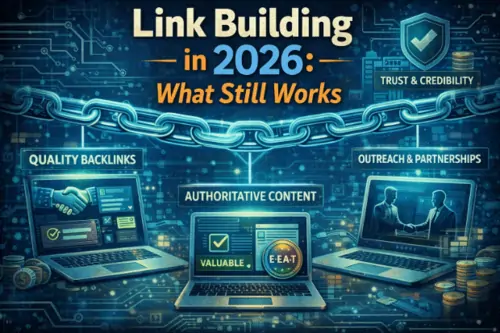
Link building in 2026 is still a ranking lever.
But the playbook has changed in one critical way: Google is far better at discounting manipulative links—and far faster at identifying patterns that look manufactured. Google’s spam policies explicitly target link spam and other deceptive practices that undermine search quality.
So what still works?
Not “more links.”
Not mass outreach templates.
Not buying placements dressed up as “editorial.”
What still works is building links that behave like real-world reputation signals: earned mentions, citations, partnerships, and coverage that would exist even if SEO didn’t.
Here’s what’s still effective in 2026—and what’s quietly becoming a liability.
What Still Works for Link Building in 2026
1. Digital PR That Earns Editorial Links
Digital PR is the cleanest link strategy because it produces what Google actually wants to reward: credible third-party validation.
This includes:
- data-driven reports (original stats, surveys, market snapshots)
- expert commentary that gets cited
- newsworthy angles that publishers actually want
The point isn’t “getting a DA90 link.”
It’s earning coverage that comes with:
- brand mentions
- referral traffic
- trust signals that compound over time
Digital PR remains a core modern strategy for earning high-quality links through real stories and assets, not manufactured placements.
The Bottom Line: Editorial links are still the safest links—because they’re the hardest to fake.
2. Original Data Assets (The Link Magnet That Doesn’t Expire)
If you want consistent links without constant outreach, publish something worth citing.
What works in 2026:
- industry benchmarks
- pricing trackers
- “state of the market” reports
- calculators and interactive tools
- curated datasets or directories (done with quality control)
When your page becomes a reference, links become a byproduct—not the goal.
The Bottom Line: The best backlinks come from being the source.
3. Relationship-Based Outreach (Not Spray-and-Pray)
Cold outreach still works—when it’s targeted and respectful.
The shift is from volume to relevance:
- fewer sites
- better fit
- stronger angle
- real mutual value
Think:
- co-marketing with complementary brands
- partner pages that genuinely help users
- community collaborations (events, webinars, joint research)
The Bottom Line: Relationships scale better than templates.
4. Linkable “Utility Content” (Not Just Blog Posts)
Generic blog posts don’t attract links anymore—because every SERP is flooded with them.
What earns links now are utility pages that other writers need to reference:
- definitive glossaries (not thin definitions)
- compliance checklists
- comparison matrices
- “how it works” explainers with visuals
- updated resource hubs (actively maintained)
The Bottom Line: Links follow usefulness.
5. Strategic Partnerships and Real Citations
In 2026, some of the best links come from places SEOs used to ignore:
- suppliers
- distributors
- clients (case studies)
- industry associations
- chambers, orgs, universities, and local programs
These are harder to fake and often come with real-world legitimacy.
The Bottom Line: The most valuable links often look boring—but they’re real.
6. Local Links That Strengthen Map Pack Visibility
For PH businesses (and any local brand), links that reinforce local legitimacy still matter:
- local news coverage
- local business directories with editorial review
- event sponsorships
- barangay/city org pages (when relevant)
- local partner ecosystems
The win is not just rankings—it’s authority alignment across your local footprint.
The Bottom Line: Local SEO links work when they prove you’re a real entity.
What Doesn’t Work (Or Works Until It Hurts)
1. Paid Links Disguised as Editorial
If the primary purpose is manipulating rankings, you’re not building authority—you’re building risk.
Google’s spam policies focus on behaviors that undermine search quality, including link spam tactics.
The Bottom Line: If you wouldn’t buy it without SEO value, it’s probably not worth the risk.
2. Scaled “Guest Posting” With No Real Standards
Guest posting isn’t dead. Mass guest posting is.
If it’s thin, repetitive, or clearly produced to place links at scale, it becomes part of a pattern that’s easy to devalue.
The Bottom Line: Quality guest content can still earn trust. Guest-post factories don’t.
3. Parasite-Style Publishing and Reputation Piggybacking
Google has explicitly targeted “site reputation abuse” (often discussed as parasite SEO)—where third-party content is published on a reputable domain to exploit its ranking signals.
Even the broader policy environment shows how serious this has become, including regulatory scrutiny around enforcement impacts.
The Bottom Line: Borrowed authority is temporary. Build your own.
The 2026 Link Building Framework (Simple and Durable)
If you want link building that survives updates, build around three buckets:
1) Earned (Best)
- PR coverage
- citations
- organic mentions
2) Created (Okay when legit)
- partner pages
- case studies
- community listings with quality gates
3) Manipulated (Avoid)
- paid placements to influence rankings
- large-scale low-quality guest posting
- anything designed to “manufacture” authority
The Bottom Line: The closer your links are to real reputation, the safer they are.
Final Thoughts
Link building in 2026 still works—but only when it looks like what it’s supposed to represent: trust.
If your strategy produces links that:
- make sense editorially,
- generate referral traffic,
- and validate your brand in your industry,
…you won’t need to fear crackdowns, policy shifts, or algorithm turbulence.
Because you’re not gaming the system. You’re building reputation.
Frequently Asked Questions
Do backlinks still matter in 2026?
Yes. But quality and relevance matter far more than volume. Google’s spam policies reflect a focus on preventing manipulative practices.
Is guest posting still effective?
Only when it’s high-quality, relevant, and genuinely editorial—rather than scaled purely for links.
What’s the safest link building strategy today?
Digital PR + original data assets + real partnerships. These produce links that are hardest to fake and easiest to justify.