
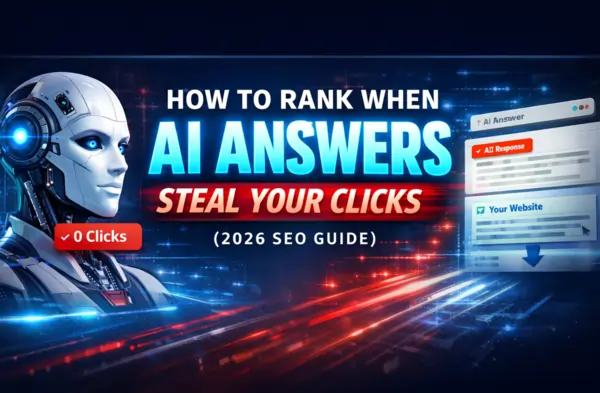
AI is changing search. You see it everywhere: AI Overviews, Featured Snippets, and instant summaries.
For many searches, users get their answer immediately. They don’t need to click on a website anymore.
If you see your impressions (views) going up but your clicks staying flat, don’t panic. You are not doing it wrong. This is the new normal.
But here is the most important rule for 2026: Ranking still matters, even if users don’t click.
This guide explains why clicks are dropping and how to adapt your SEO strategy to win in the age of AI.
Table of Contents
Why Are AI Answers Stealing Clicks?

Search engines like Google have changed. They are no longer just a list of links. They are now “Answer Engines.”
AI aims to answer simple questions fast. It reduces clicks for searches like:
- “What is [Topic]?”
- “How does [Thing] work?”
- “Quick summary of [Event]”
When AI answers these questions, users stay on the search page. This is called a Zero-Click Search.
However, this does not mean SEO is dead. It just means the goal has moved. We are shifting from Traffic-Based SEO to Influence-Based SEO.
5 Ways to Rank When AI Takes the Clicks
To succeed in 2026, you need to change how you write content. You must be the source that the AI trusts.
1. Focus on “Context,” Not Just Keywords
AI does not just look for keywords. It looks for facts and connections. It wants to know you understand the whole topic.
- Don’t just answer “What is X?” The AI can do that easily.
- Do explain: Why X matters, how it works, when to use it, and what the risks are.
SEO Tip: Google ranks pages that cover a topic completely. Make sure your content answers the “Who, What, Where, When, and Why.”
2. Format Your Content for Robots
If an AI cannot read your content clearly, it will ignore you. You must make your page easy to scan.
- Use clear Headings (H2 and H3): Tell Google exactly what each section is about.
- Give direct answers: Put a clear definition right after the heading.
- Use lists and tables: AI loves structured data.
Why this works: When your content is organized, AI systems can easily “extract” your information and show it in the answer box.
3. Become the “Second Click”
The AI handles the “First Click” (the basic summary). Your job is to earn the “Second Click.”
Users click on a website when they need more than a summary. They click for:
- Deep details: Complex instructions that a summary skips.
- Real experience: Stories from real humans, not machines.
- Opinions and advice: “Is this worth my money?”
- Data and proof: Charts, studies, and original research.
Action Step: Review your content. If you only say what ChatGPT can say, you need to add more depth.
4. Build Your Brand Authority
When users read an AI answer, they often check if it is true. They look for a trusted brand to verify the information.
If your brand is famous for a specific topic, users will search for you directly.
- Example search: “Is [Topic] safe [Your Brand Name]“
To rank in 2026, you must build a reputation. Be the expert that the AI cites as a source.
5. Answer Questions AI Can’t Answer
AI is great at facts, but it is bad at judgment. It cannot tell you what is “best” for your specific situation because it doesn’t have real-world experience.
Write content that targets these complex questions:
- “Is X worth it for small business?”
- “Risks of using Y in 2026”
- “My personal review of Z”
These searches have fewer people, but those people are much more likely to click and buy.
How to Measure Success in the AI Era
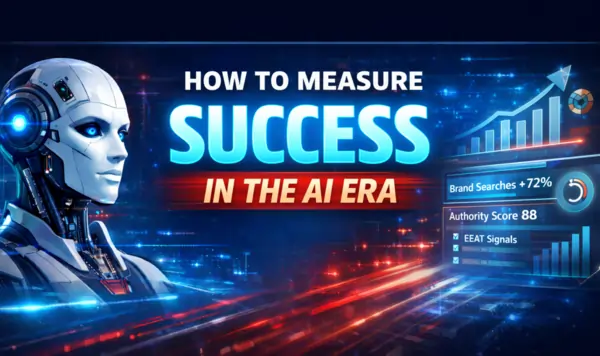
If you only look at “Clicks,” you might think your SEO is failing. You need to look at the bigger picture.
Track these metrics instead:
- Impressions: Is your brand showing up in search results?
- Brand Mentions: Are people talking about you?
- Conversion Rate: Are the people who do click actually buying?
The Bottom Line: Ranking without clicks still builds trust. When users see your name in the AI answer, they remember you.
Conclusion: Don’t Fight the AI, Feed It
AI answers didn’t break SEO. They just exposed weak content.
If you want to rank today, stop trying to trick the system. Start providing real value.
- Write for humans (experience and depth).
- Format for robots (structure and clarity).
- Build a brand that people trust.
This is how you survive—and grow—when AI answers steal your clicks.
Frequently Asked Questions
Can you still rank when AI answers reduce clicks?
Yes. Ranking still matters because AI answers rely on authoritative sources. Visibility, citations, and brand trust continue to influence conversions even without clicks.
Should SEOs stop targeting informational keywords?
No. Informational keywords still build authority and support AI visibility. The strategy changes, not the keyword type.
How do you get clicks when AI already answers the question?
By offering depth, experience, examples, and nuance that AI summaries cannot fully provide.
What metrics matter more than clicks now?
Impressions, brand searches, assisted conversions, lead quality, and sales influence matter more than raw traffic.
Does this mean SEO is less profitable?
No. It means SEO is less about volume and more about impact and intent.
External Resources & References
🧠 Official Search Engine Guidance
- Google on AI-Generated Content & Search
https://developers.google.com/search/blog/2023/02/google-search-and-ai-content
Google’s explanation of how AI content and search answers are interpreted in results. - Google Search Central Documentation
https://developers.google.com/search/docs
Comprehensive official guidance on crawling, indexing, SERP features, quality signals, and structured data. - Google on Search Quality & Helpful Content
https://developers.google.com/search/docs/quality-rater-guidelines/overview
Insight into how search quality is evaluated and why authority/context matter beyond clicks.
🤖 Industry Coverage on AI & Search
- Search Engine Journal – AI & Search
https://www.searchenginejournal.com/category/artificial-intelligence/
SEO industry insights on how AI features influence search behavior and visibility. - Search Engine Land – AI Overviews & SERP Features
https://searchengineland.com/library/google/google-search-features
Deep dive into how rich results, answer boxes, and AI summaries alter click patterns. - Moz – Search Visibility Concept
https://moz.com/learn/seo/search-visibility
Understanding visibility beyond rankings and how visibility impacts authority and relevance. - Ahrefs – Search Intent & Keyword Context
https://ahrefs.com/blog/search-intent/
Practical guidance on interpreting user intent and structuring content for modern SERPs.
📊 SEO Thought Leadership & Analysis
- Semrush Blog – SEO & AI Trends
https://www.semrush.com/blog/category/ai/
Analysis of SEO trends influenced by AI, machine learning, and semantic understanding. - Backlinko – Modern SEO Ranking Factors
https://backlinko.com/search-engine-ranking
Data-driven exploration of ranking factors in current search ecosystems.
Written by Jin Grey
Jin Grey is a Full-Stack SEO Expert with 18+ years of hands-on experience across technical SEO, content systems, and long-term search strategy. She writes from real-world execution and testing, not theory.
She also publishes practical SEO eBooks focused on sustainable SEO systems and modern search strategy at https://jingrey.com.